Backyard Adventures

Thursday, March 18, 2010

The Bataan Memorial Death March

March 21, 2010 - The pals and I are going to experience the Bataan Memorial Death March. It is a challenging march through the high desert terrain of White Sands Missile Range, N.M., conducted in honor of the heroic service members who defended the Philippine Islands during World War II. These men sacrificing their freedom, health and, in many cases, their very lives. I hope to see some of the surviving members of the original march. It is suppose to be aw-inspiring to see these original folks. I don’t really know what to expect, as this is my first 26.2 march. I will be in full uniform, but no packs and soldier gear. I have done a few marathons before, but posts from some of the previous marcher, the hill, the sand pit, the wind, I don’t know how to put these events into the long-term memory yet. Some say the experience was eventful, grueling, and the best trip and most rewarding trip of their lives. I shall soon see Sunday. We are getting a breakfast that morning, a film from the original march, and a very nice ceremony at the start is supposed to take place. I am looking forward to it. Wish us luck and I will try to post events as they happen. Don’t forget pictures. Brendan, are you ready to be put in the pocket?

Labels: , ,

Wednesday, February 24, 2010

BNCOC Experience, Fort Eustis, Virginia Adventures

Graduation from an Army Non-Commissioned Officer school is an accomplishment, as soldiers must complete the Basic Noncommissioned Officer Course (BNCOC) to be considered for promotion to Sergeant First Class and above. The course consists of four phases (as an 88M), which is an Army job-related program that teaches sergeants aspects of combat arms, combat support and service support. BNCOC is conducted at locations specific to an Army job, as in my case 88M, Motor Transport Operator, located at Fort Eustis, Virginia. My Phase 1 (Common Corps) was done at Camp Williams, Utah.

The purpose of the Basic Noncommissioned Officer Course (which is switching over to a new name called Advanced Leaders Course) provides training in leadership, management, technical and tactical skills to perform as Motor Transport squad leaders under varying field conditions and convoy operations. To compliment the training Small Group Instructors build on previously acquired skills (from BNCOC Common Corps – Phase 1 and WLC, Worrier Leader Course) while introducing new doctrine, new automated systems and equipment, and support for squad leader responsibilities. This includes squad leader duties, tactical convoy operations and movements, contemporary operating environments and lessons learned, and tactical and conventional decision-making. Stressed during the school were force protection, warrior leader, and AAR (After Action Review) skills.

There are stories on the Internet that state that this school was “easy” that “it was a joke and soldiers should know most of these skills already,” or “that school only taught basic skills I already know.” But I think the ultimate goal of an NCO school, such as BNCOC is to teach a baseline of material for soldiers, not just the ones that have been to theater, but to all soldiers so they can bring their vast knowledge into focus. An example would be convoy operations. In theater, there are many ways that soldiers can conduct convoy operations. The school teaches the basics on how TRADOC would want a convoy to be run. I also thing the schools focus on building quiet leaders and soldiers that have had limited overseas experience. Not everyone gets to go out on convoys, so these skills build on things that sergeants should already know and or can improve upon.

This was the final phase for me at BNCOC, which was conducted at Fort Eustis. The class was very well versed in its solder skills and 88M proficiency. Most of the soldiers did really well on the final exam as well. In fact, most of the soldiers did so well, Honor Graduate skewed the curve so only the few soldiers that got 100% on the exam got the honorable category on their diploma. This class also had the first female soldier to receive Distinguished Honor Graduate. The field exercise also showed the good leaders from the inexperienced. The 11Bs or infantry soldiers knew their tactics, mission and operation order tactics very well, and it showed up the soldiers that didn’t have this experience. It was an asset during the urban operation drills.

The curriculum at this final phase consisted of Warrior Leader Training, Urban Operations, React to a Possible Improvised Explosive Devices, Request Medical Evacuation, Defense Advanced GPS Receiver (DAGR), MOUNT (urban operations) training, Battle Damage Assessment and Repair (BDAR) Procedures, and US Weapons, to include the M2 50 Cal, M249, and M240B. Finally, the class participated in a Situational Training Exercise (STX), which was in a field environment where soldiers performed first hand urban and convoy operations, force protection, and other warrior related tasks. The STX was five days in the field, located at the far end of Fort Eustis off the James River at FOB Dragon. All I can say about that was it was cold.

Some brief highlights of the trip included convoy and urban operations, saving the photographer, saving the downed pilot and eradicating the town of insurgents. The chow was fare, but the kiddy chow hall (the chow hall where the basic training soldiers ate at) was much more appetizing that the 7th Transportation Group chow hall. And you would think the new and improved chow hall would be better? Eating out after graduation and the texting of our family and friends - More or less spamming and giggling was a major highlight and a release after the completion of the class. This is where the pickle showed up on the rental vehicle. Yes, I was concerned as well. Five days out in the FOB next to the James River in the dead of winter was exhilarating. I am glad there was heat in the tents. We had ALL our snivel gear on. I am thankful for polypropylene. Air and Rail movements were great classes as well and we got to ride the Fort Eustis Express with our loaded vehicles. I assisted in the Air Movement class as a primary instructor (as my class instruction), which was also an eventful class. Classes at the NCO academy were uneventful and the test was mostly easy. “It is what it is” was the class motto and everyone dealt with peer leadership as it was presented to him or her. Most of the experienced leaders stepped up to the plate and the day-to-day activities became routine. Graduation at the NCO academy was impressive as we sang the Transportation and Army song, and we recited the NCO Creed. And we were left to our own devices on the way home to our units. I hope everyone took something away from this experience. One of the speakers at graduation had an inspiring speech I wish I could have received a copy of. I’ll try to write what I heard in a future blog article, as it is relevant to my overseas experience. This final phase wrapped up the experience for me after graduation, and I was inspired by the talent in our class.

And finally, the highlight of the trip was graduation and a trip to the Virginia Mariners Museum prior to flight operations and home station. The museum was home to parts of the original ironclad submarine, the Monitor. I recommend that anyone visiting the area should go visit this museum. The docent said, “You should have at least three hours to spend in here to see everything.” I thought he was kidding by just looking at the entrance--it wasn’t a grand entrance and the buildings outside looked small. But we were deceived. The large inner rooms kept going on and on, with model ships, harbor buoys, the Monitor movies, old bottles and historic artifacts, and not to mention Navy submarine and ship exhibits, and parts of large wooded sailing vessels. I think you would need an entire day to see everything here.


Well that summarizes my trip to Virginia, and a peek for future soldiers visiting BNCOC and Fort Eustis. I will have to attend ANCOC (Advanced Non-Commissioned Officer Course) here. I am sure a new name will apply when I finally have to go back. But the adventure was fun and educational. I hope you enjoy your NCO schools and it just isn’t a “check the box” experience.

Labels: ,

Sunday, November 09, 2008

Dining Out 2008

I was inspired by Ashleigh's great post to post our own Dining Out picture-our story of that evening isn't nearly as exciting as hers, but no doubt next year, it will be! :)

So...here's me, my handsome soldier and Baby Brendan, too, if you look carefully.

Labels: , ,

Tuesday, September 16, 2008

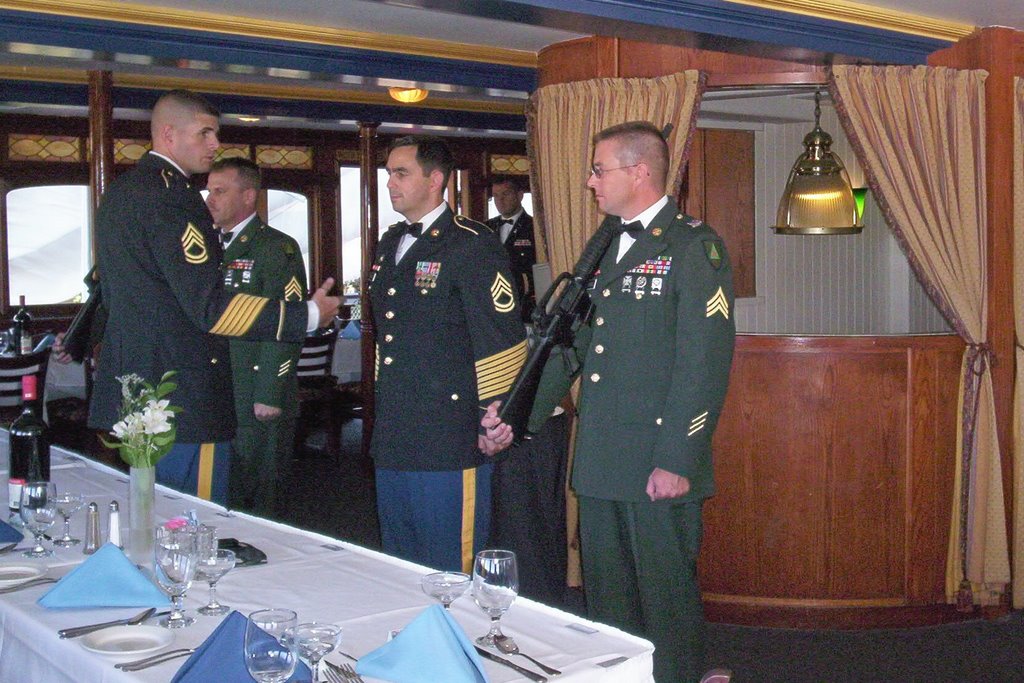
Sean’s Reserve Unit’s Dinning-out


A Dining-out is a formal military ceremony for members of a company or other unit, which includes a dinner, drinking, and other events to foster camaraderie and esprit de corps. The United States Army refers to this event as a dining-out. The dining-out is a formal event for all unit members and their families. Here we are at Sean’s Reserve Unit’s Dinning-out.

Labels: ,

Wednesday, June 25, 2008

Fort Hunter Liggett Scout Reservation


Fort Hunter Liggett Scout Reservation Photos
Pacific Warrior 2008
(Click on the picture above)

Labels:

Tuesday, June 24, 2008

Boys At Camp


Ok, so it's not camp really....it's training. Sean is quite busy, and working very hard training soldiers who are going over to the sandy spot. Sometimes his days are 12 hours or more.

As you may have heard, there are 500 fires burning in our state, and this air quality is pretty icky, not to mention the unbearable heat! But, all in all, though he's excited to be coming home this week, he's having a great time.
Can't wait for us all to be home together. Finally. :)

Labels:

Thursday, April 24, 2008

Opinion of the Army Combat Uniform (ACUs)

Opinion of the Army Combat Uniform (ACUs)

The Army Combat Uniform (ACUs) is the current combat uniform worn by the United States Army, which was fielded in April 2005. It replaced the Battle Dress Uniform (BDUs) and Desert Camouflage Uniform (DCUs) and features a number of design changes, modifications that are undesirable for some. This article represents my opinion of the uniform.

Complaint Number One, Cost

First of all, I would like to complain about the cost. The cost for BDUs, to include the pants and the shirt/jacket was roughly 50$. ACUs costs roughly $76 per ensemble. The Army (Reserves) gives you an initial issue of two, and a year later, two more: That’s it, nada, no more! The Army states that a clothing allowance has been adjusted for the more expensive uniforms. That means in the Reserves, you don’t get to replace your uniforms as often. “Hmmm I don’t remember a clothing allowance in the Reserves either. I better check my LES.” All of the insignia and patches are an extra cost too. This includes patches, name and branch tapes, and skill tabs, which is all backed with new Velcro. But to save in the cost to the soldier, they made everything Velcro (to save Private Snuffy from sewing all his insignia). “Ok, so I have to purchase more expensive patches and tapes with the new Velcro backing, and I have to replace them every time I switch uniforms?” The subdued patches are quit expensive also. This is an extra cost, because the patches wear out faster because soldiers constantly have to take them on and off every time they put on a new uniform. The Army states that this is a cost savings measure, as we don’t have to sew on rank and patches any more. I didn’t mind taking my uniform down to the cleaners to get a nice sew-on patch. But I have to purchase more flags and patches as they wear out faster. Did I mention the patches get dirty in the field? You can’t just wash them on your uniform as they get frayed more than sew on patches. Go figure! I will address patches and tabs in a moment. My initial point was cost of the uniforms, cost of the patches and tabs, and additional cost due to uniform replacement. I will mention durability in an upcoming complaint.

Complaint Number Two, Velcro

My second complaint is the Velcro sucks! It literally sucks (or sticks) to everything but the patches, and don’t get mud or dirt on the Velcro hooks and fasteners. It doesn’t work well with mud. I found out also that you have to turn the uniform inside out when you wash them, as the Velcro and uniforms all stick together during the wash and dryer cycle. The Army states that the Velcro patches are so when you get captured, you can take your name and rank off and they enemy won’t know your name or position. I can do that just as fast with a Gerber in my hand if I get captured. Now wait a minute! I also have to take all the nameplates and patches off in the laundry, an incident for a potential loss of a rank or unit patch. We have 160,000 people in Iraq and a third of that in Afghanistan. How often do soldiers need to take their Velcro patches off? Special Forces need to take off their patches, I don’t! The uniform also features hook and loop fasteners on the pockets, and the noise associated with opening Velcro fasteners give away a soldier's position in the field. The Army has stated, “That the noise issue has been determined to be a minor issue that can be negated with correct noise discipline.” Hog wash! What was wrong with all the buttons? They worked fine on the BDUs, and now that we don’t have to starch our uniforms, the buttons worked great (The starch on the uniforms made the buttons stand out). This isn’t a problem, as we don’t have to starch our uniforms any more. Furthermore, several of my soldiers have expressed concern about the Velcro on the ACU. Dirt and mud clog the hooks and loops and they wear out with use. Zippers have also been a topic of concern as well. Soldiers express concern because the zippers (as with any zipper) can bind up, and render the uniform uncomfortable to wear, especially with body armor. Bring back the buttons!

Complaint Number Three, Little Thingies

What do all the little thingies around the uniform do? I’ll start with Little Thingy Number One, the strings around the waist (i.e. the drawstring waist band). You don’t need little strings if you wear a belt, and a belt is required on the ACU pants. Hence, there is no need for little strings.

Little Thingy Number Two, the String Tightener (i.e. in the pant-thigh pockets called hook and loop closures). When do you use these? If you put a canteen in your pants pocket, you don’t need the string tightener to hold your canteen into your pocket. The Army took away all my canteens anyway and gave me a Camelback. Hence, you don’t need to tighten anything in these pockets. By the way, have you ever sat down on the string tightener? In a class all day long watching power point slides, a string tightener is not something fun to sit on.

Little Thingy Number Three, Tiny Ankle Pockets. Have you ever used the tiny little pockets above the ankles? What are these for? I am not sure if a pack of smokes will even fit in one of these. I don’t smoke so I don’t need a little pocket. “Maybe I can put a spare magazine in them? Nope, these are too small for anything practical. I bet I can put something useful in them, unless I forget what is in there prior to laundry. I know, I can put all those little cards the Army gives you (i.e. the CFLCC ROE, insect bite, Army values, and the IED Smart cards) in there.”

Little Thingy Number Four, IR IFF Little Squares. Has anyone had to use the IR squares yet? “The jacket/shirt features permanent IR IFF squares that are sewn to each shoulder for nighttime identification. These reflect infrared light and can be easily seen with night vision devices. They are protected by Velcro tabs in garrison or when not in use.” I think these are placed on the uniform so sergeant majors can walk by and correct young soldiers displaying these little black squares. I think these are useless. I don’t want to be seen in the field with my black square showing in my NVGs. I am sure there is a better alternative than putting these all over the uniform. How many soldiers in the entire inventory need little black squares on their uniform? I bet it is less than one percent. By the way, “cat eyes” work great on my Kevlar, not on my uniform when I am trying to conceal myself from the enemy. Do helicopters need to see soldiers from below with their little IR squares? If you buy ACU’s from the surplus store or on line, you can avoid uniforms with Little Thingy Number Four.

Little Thingy Number Five, drawstrings on your ankle/pants. If you blouse your boots correctly or put your pant legs into your boots, these stings get in the way. I find these strings useless as I put my pant legs into my boots so creatures and dirt from the field don’t get into my boots. If you blouse your boots, the strings easily become untied throughout the day. Please get rid of little strings.

Little Thingy Number Six, Zippers. I like zippers, just not on my ACUs. Bring back buttons!

One of My Most Annoying Little Thingy Number Seven, the Mandarin Collar. The collar rubs your neck and gives you a rash. In body armor it is even worse. I like the Elvis collar on the BDU’s even better than the rash-collar on the new ACU’s. I don’t know how you would fix this annoyance, but I am sure someone can design a collar that doesn’t rub on your neck all day.

Lastly, A Good Little Thingy, the penholders. Little Thingy Number Eight is a good addition to the uniform. I like the three-slot pen pocket on the left arm of the jacket. But I still reach to my chest for a pen now and again, and to my luck there is no pen found there anymore.

Complaint Number Four, ACU Fabric

“The nylon cotton fabric does not breathe as well as the cotton DCUs and results in a hotter uniform in high temperature climates.” I liked the DCU material. It was a lot cooler and not as bulky as the new uniform. It seems the BDU and DCU uniforms where much more durable too. “Hmmmm should I put this in the cost category?” Early ACU uniform also had several issues with durability, such as ripping seams. I have seen this first hand with stitching coming undone. In later ACU uniforms this is still a continuing problem. “Reports of low durability may not take into account that the designed wear-life of the ACU is only six months.” Let me re-cap, a more costly uniform lasting only six months, no clothing allowance, and only two uniforms issued per year? This is a great reason to switch to ACUs. I won’t even go into the universal camouflage pattern. “Yes I will!” I like the picture of the soldier being camouflaged on the couch that went around the Internet some time back. The blog that has the camouflaged couch said this: “Many of us have asked the simple question...What environment is the ACU uniform made for. It doesn't seem to blend into our comfy tree lines. It tends to clash with urban areas. One of my Soldiers found the perfect background while napping on his Grandmother's couch. Now we just have to find a way to harden this piece of furniture and make it tactical. Cost effective of course.” http://miserabledonuts.blogspot.com/2007/02/acu-test.html When I was at Fort Lewis last year, “Look over there, a person with ACUs in the trees” when you couldn’t see the woodland BDU uniform in the distance. Go figure!

“Although common practice (though not required by regulation) with the BDUs, ACUs are not to be starched.” This will be changed soon too right? It will only be a matter of time when some command sergeant major will want a pretty uniform when I go to the field. “Starching the uniform has been shown to cause discoloration. It enhances the IR signature, making the uniform brighter when viewed with night vision goggles. In addition, personnel have been instructed that the uniform must be washed with a mild detergent that does not contain "optical brighteners." Detergents with optical brighteners may cause discoloration of the uniform, which would nullify the purpose of the very specific camouflage design and result in possible unwanted detection of personnel using the uniforms in combat. Some detergents have phosphorescent properties which enhance an enemy's ability to see the soldier when viewed with Night Vision Devices.” So, I have to use Woolite, I can’t use Tide any more to get the stains out, they aren’t durable, they don’t breath, and nullifying the purpose of a uniform is now more important than killing and breaking things. I think the Army got hosed on this appropriations bill.


Complaint Number Six, Patches, Pins, Badges and Tapes

You get two sets of patches that you have to keep track of. Since I had several BDU uniforms, I never lost flags, pins and rank. I am not that prone to losing things, but that little rank patch on the sternum seems to go missing a lot. I had to borrow from my buddy last drill. “It is great for promoting female soldiers,” As my wife has pointed out to me also. Sewing eliminates this problem and they look better than these thick bulky patches. The patches get more abuse to constant pulling on and off of uniforms as I stated earlier, as well as the patches get dirty because they don’t get sewn on.

Another dumb idea is that skill badges (such as airborne and air assault tabs) are worn as pin-on only. This is stupid! Why do they call the brass pins that hook the skill tabs to the uniform “Dammits” for? Because they fall off easily, “dammit”! In the field, skill tabs go missing easily. Who is the bureaucrat that is against sewing patches to the uniform? It looks nice, and pin-on rank and badges fall off easily. They also get scuffed up more readily than patches. Pinning of the airborne “chest candy” is a pain. By the way, the IR American (sticker) flag is ugly, get rid of it. I am still confused why the flag is backwards too. The Army states, “It is positioned so that the star field faces forward, or to the flag's right. This gives the impression that the soldier is advancing into battle with the flag unfurling behind them.” Can someone explain this to me? Does the enemy really care if we are advancing or not by our flag coming towards them? Bring back the regular flag. I think subdued flags would be fine also.

I like the boots and I am glad that we don’t have to shine boots again. However, berets have replaced the boot shinning mantra, with “Your beret looks like crap, fix it” complaint. This is often followed with the “Don’t you know how to shave your beret, or “Don’t you know how to shape your beret?” My response is, “It looks like the picture in the manual” and “It says in the book I am not suppose to shave the beret.” I can do a whole story on what soldiers feel about this useless piece of itchy fabric. Should I start by saying it itches, it doesn’t provide me with cover from the sun, and it can’t be shoved into my pocket without getting wrinkly? They need to be used with the Class A uniform only. The Rangers can have them back. I want my soft cap back! I am still trying to figure out when I am supposed to bring my beret to drill or my soft cap. Field soldiers don’t need a useless piece of fabric itching when on patrol.

I don’t have a problem rolling the sleeves down, as required with the ACUs. Rolling the sleeves up in the summer time was a pain. Plus you never knew when you could or couldn’t have your sleeves up anyway. My sleeves never seem to stay up throughout the day. Sleeves down are better anyway as for sun exposure and creatures biting your arm. It helps in the heat to. Also, I think I like the pouches for knee-pad/elbow-pad inserts. This is a nice idea, but I have only used it while at the range. Maybe I need to go in the field again soon, as I am getting rusty on my tactical skills. Furthermore, pocket placement on the ACUs is adequate. It may have been a good idea to get rid of the lower-shirt pockets, as these pockets were useless for putting items in there.

To sum up my complaints are as follows: Cost, Velcro, Useless Little Thingies, Fabric and Durability, Pins and Patches, and Sewing. With all the soldiers in uniform around the world on a daily basis, you would think the Army would take in consideration the conditions we work in, the cost to the soldier, and the needs the soldier has. Next time some three-star wants to make a promotion by fielding junk, ask the young soldier what his needs are. As him if all this stuff on the uniform is necessary, make the uniform durable, make it useful, make it cost effective for the private that gets a minimal uniform allowance, and make it functional for the entire Army.

You can read about the wear and appearance, parts and care, initial fielding, and other aspects of the material and patterns at Wikipedia:
http://en.wikipedia.org/wiki/Army_Combat_Uniform

Labels:

Wednesday, February 13, 2008

Yay, Boy!

For patriotism, valor, fidelity and professional excellence.
Well done!

Labels:

Wednesday, December 12, 2007

Remembering Pearl Harbor

Remembering Pearl Harbor
By DAVID LIPPMAN

Friday, December 7th 2007, 9:02 AM

AP

The deck of the destroyer USS Shaw explodes after being bombed during the Japanese surprise attack on Pearl Harbor, Hawaii on Dec. 7, 1941.

Getty

A B-17C Flying Fortess bomber lies crippled after a strafing run by Japanese fighters. It's the singular event that forced an entire generation to become the greatest in the nation's history. Sixty six years after the surprise attack on the U.S. naval base at Pearl Harbor plunged the country into World War II, David Lippman gives a detailed account of the events leading up to that fateful day.

December 6th, 1941
[The] lead domestic American news stories that day are a car crash in Baltimore, a train wreck in Kentucky, the death of a Civil War veteran, and the murder of a 12-year-old girl at a "petting party." In Seattle, a gun-toting burglar breaks into a local doctor's home at 4:30 a.m., and makes off with a purse's entire contents: 15 cents. As there are only 16 shopping days til Christmas, newspapers are packed with ads, which link consumer goods to the defense push ("This Christmas...Give the 8 Freedoms of (Glover) Pajamas That Really Fit!") The New York Times headlines its story on Japan's aggressive tone: "Japan rattles sword but echo is pianissimo." Life magazine says "Japan is desperate and getting weaker every day."

That afternoon, Japan sends a the first segments of a 14- part message to its embassy in Washington, ordering them to present their final demands to the United States at 1 p.m. Washington time, tomorrow. This message is intercepted and decoded by the Americans faster than the Japanese can do it.

This intelligence lands in the hands of Lt. Cdr. Alvin Kramer of the Navy's Cryptographic Department, who drives around Washington that evening, showing the message to top officials. The message indicates that the Japanese intend to break off negotiations completely, and is filled with inconclusive posturing.

President Franklin D. Roosevelt reads the document, and says "This means war." He then sends a personal message to Japan's Emperor Hirohito, begging him to start negotiations afresh. Other American senior officers are less certain that the message means war. Some senior officers, like Gen. George C. Marshall, Army Chief of Staff, and Rear Adm. Richmond K. Turner, Chief of War Plans, cannot be reached that evening. No warnings go out to Hawaii, or anywhere else, for that matter.

When Roosevelt's message reaches Tokyo (after a long delay by the Japanese telegraph agency), US Ambassador Robert C. Grew passes it on to the Foreign Ministry and asks for an immediate audience with the Emperor. Prime Minister Hideki Tojo, the fiercest militarist, denies the American request.

At Pearl Harbor, all eight battleships of the Pacific Fleet are in port, and all three carriers are at sea.

On the battleship USS Arizona, YN3 Oree Weller stands zone inspection in the ship's navigation office. He just manages to clean up dripping red paint before CAPT Franklin Van Valkenburgh inspects the space. Weller's space passes inspection, and Weller is handed his liberty card for that evening.

"A river of white flows down Hotel Street" that evening as thousands of Sailors descend on Honolulu's main entertainment area, filled with shooting galleries, pinball machines, taxi- dancehalls, and cafes named the Black Cat, the Bunny Ranch, or Lousy Lui's. However, both the Shore Patrol and the Military Police have a quiet night...one Sailor is jailed for a "malicious conversation," and another from USS California for using a shipmate's liberty card. Only 80 out of 100,000 military on liberty or pass are carted off to brigs and guardhouses.

Many Sailors and soldiers enjoy simpler pleasures. PFC Aloysius Manuszewski has a beer at the PX, and then writes home to his parents in Buffalo, N.Y. Officers' clubs hold small parties and Dutch treats. ENS Victor Delano spends a properly respectful evening at the home of RADM Isaac C. Kidd, who is COMBATDIV 2. It is the last night Kidd will be alive.

A lot of Sailors go Pearl Harbor's Bloch Recreation Arena, where the main event is the "Battle of Music," a musical contest between ship's bands. The contest is won by USS Pennsylvania.

The band of USS Arizona finishes second. The musicians are rewarded by being allowed to sleep late the following day. Not one member of Arizona's band survives the attack.

At midnight, Hawaii's stern blue laws kick in. At bars and clubs throughout Honolulu, the National Anthem is played. Sailors and Soldiers snap to attention, face the music, then race for the doors, buses, and liberty boats.

Some have to work. The swing shift at the Pearl Harbor drydock puts new steel plates on the destroyer USS Downes and aligns boring bars on the USS Pennsylvania's propeller shafts, while loudspeakers blare "Moonlight Serenade." Japanese midget submarines use the work lights to navigate towards the base.

Radio station KGMB is ordered to stay on the air after midnight to guide in a flight of 12 B-17 Flying Fortresses due in from the West Coast.

North of Hawaii, the attacking Japanese task force increases speed to 25 knots, and six midget submarines are released from their mother boats off Oahu, in a bid to cause additional chaos at Pearl Harbor. Among them is a midget sub commanded by Ensign Kazuo Sakamaki.

On the carrier Akagi, Vice Adm. Chuichi Nagumo sends a message to his fleet: "The fate of the Empire rests on this enterprise. Every man must devote himself totally to the task at hand."

December 7, 1941
Japan's first act of aggression that day is not the bombing of Pearl Harbor, but the laying of mines off the coast of Malaya to cover the invasion. Shortly after 3 a.m. local time, Japanese infantrymen of the Imperial Guards Division come ashore in Malaya, and run into stiff machinegun fire from British and Indian troops of the 8th Indian Brigade.

Meanwhile, at 9 a.m. in Washington, the last part of the 14- part message arrives. The missing piece does not mention the attack, it merely says negotiations have come to a standstill and must be ended. Another message follows: the 14-part telegram must be delivered to US Secretary of State Cordell Hull by 1 p.m. Washington time, 7:30 a.m. in Hawaii.

The Japanese Embassy staff have enormous difficulty decoding it and translating it into English. They do not know it must be delivered at 1 p.m. or why. Their typist, Katsuzo Okaumura, a junior diplomat, is a two-fingered typist at best, and makes numerous mistakes. Convinced his typing will lose him face, he wastes time re-typing the entire message.

Lt. Cdr. Alvin Kramer and Army Col. Rufus Bratton spend a hectic morning trying to alert someone in authority. Kramer fails, but Bratton finally locates Chief of Staff Gen. George C. Marshall, who determines that the Japanese mean to attack. He sends out an alert message to all Army commands, urging it be passed on to the Navy as well. But atmospherics prevent it from reaching Hawaii. Marshall orders the message sent as a telegram.

While this is going on, Vice Adm. Chuichi Nagumo hoists a battle flag on his carrier Akagi's signal block, the same one Adm. Heihachiro Togo flew at Tsushima in 1905. Shortly after that, his six carriers hurl 366 planes in two waves at Pearl Harbor.

The lead wave, led by Cdr. Mitsuo Fuchida, is guided in by KGMB radio, still playing Hawaiian songs.

As the bombers roar in, the Americans have more chances to be alerted. The US destroyer Ward, under Cdr. William Outerbridge, spots and sinks one of the midget submarines, with depth charges. But her captain's report is dismissed by his superiors. After all, this is Outerbridge's first patrol on his first command.

Army radar picks up Fuchida's incoming planes. But the fighter controller on duty, hearing the report, says, "Well, don't worry about it," figuring it is the incoming B-17s. The radar crews shut down their machine and go to breakfast.

Meanwhile, Marshall's warning arrives in Honolulu. It's not marked "urgent," so messenger Tadao Fuchikami rolls out on his Indian Scout motorcycle to deliver the telegram on his normal rounds.

At 7:50 a.m., Fuchida's lead Val dive bomber swoops in on Pearl Harbor to find the defenses unmanned, no AA fire or fighter patrols. "We've made it!" he says, and sends the famous "Tora, Tora, Tora," message, which is heard on Akagi and in Japan. His planes roar in on their attack courses, amazing American Sailors and Marines, who are busy preparing for 8:00 a.m. morning colors. At 7:53, the first bomb falls at the foot of the seaplane ramp at Pearl Harbor. In Washington, the Japanese are still typing up their message for Cordell Hull.

At Pearl Harbor, Oree Miller is reading letters from home in his office aboard USS Arizona. On USS Nevada, Lt. Joe Taussig, the Officer-of-the Deck, is wondering which size American flag to fly. On Arizona, SA Carl Christiansen waits with his brother, SN E.L. Christiansen, to go on liberty. E.L. remembers that he's left something behind, and goes below to find it. On USS Oklahoma, QM1 H.S. Kennedy, father of NASU's last CO, is standing by his rack after returning from his morning shower. On USS Maryland, SK3 Felder Crawford is reading the Sunday funnies, in which Navy Bob Steele deflects an unknown air attack on his destroyer. SN Leslie Vernon Short is addressing Christmas cards in the battleship's foretop. Pharmacist's Mate William Lynch, aboard California, hears a shipmate call: "The Russians must have a carrier visiting us. Here come some planes with the red balls showing clearly." In Ford Island's CPO family housing, Chief Albert Molter does some housework. On the north side of the harbor, 14-year-old Don Morton finds the fish are biting. At the front gate, the Marine guard stands tall as local photographer Tai Sing Loe readies his camera.

The Japanese swing in simultaneously from three directions, grooving torpedoes up the harbor. They sink five battleships in 20 minutes. Arizona meets her fate when a bomb hits her magazine, killing 1,177 Sailors, including Rear Adm. Isaac Kidd, and E.L. Christiansen. The force of the blast shakes Mitsuo Fuchida's plane overhead, and hurls Radioman Glenn Lane clean off the battleship's quarterdeck. Oklahoma takes 12 torpedoes and capsizes, trapping 125 men. Only 32 are ultimately pulled free. California and West Virginia are torn apart by bombs and torpedoes, and sunk. After a gallant effort to break out, Nevada is forced to ground herself on Barber's Point. 188 American aircraft, lined up in the center of their runways to guard against sabotage, are destroyed on the ground.

The immediate American reaction is shock, horror, and disbelief. Army officers at Hickam Air Base think the Marines are doing "realistic maneuvers" against the Navy. A Marine at MCAS Ewa yells, "Some Army pilot has gone nuts, he's diving on HQ and shooting!" A Navy officer shouts about another Army "SNAFU." But the Americans soon get the picture. A chief on Honolulu tells his men, "The war is on, the Japs are here!" One of his Sailors, charging up the ladder, mutters, "I didn't even know they were sore at us."

There are numerous examples of valor on both sides. One Japanese pilot flies his damaged plane into the side of the seaplane tender Curtiss, becoming the war's first Kamikaze. The tender survives to sail on Operation Deep Freeze II in 1956. Two midget submarines penetrate the harbor, giving destroyer crews a scare, but doing no damage before they are rammed and sunk.

American valor is enormous. Sailors, Marines, airmen, and Soldiers show no signs of panic, calmly manning their stations. Capt. Mervyn Bannion fights his battleship West Virginia until well after he is mortally wounded. Steward Dorie Miller, an African-American, mans a machine gun and knocks down an enemy plane, even though he was never trained to use the weapon. Ensign Nathan Asher, a Jew, senior officer on the destroyer USS Blue, conns his ship out of the harbor. Lts. Robert Taylor and Charles Welch get their antique P-40 fighters in the air and shoot down four enemy planes. Chaplain Howell Forgy tells his men on USS Honolulu that services are cancelled, but to "praise the Lord and pass the ammunition." AOC John Finn, lying in bed when the raid begins, runs out to the Kaneohe Naval Air Station flightline, sets up a machinegun, and opens up on enemy planes. "Although painfully wounded many times, he continued to man his gun and return the enemy's fire vigorously, and with telling effect through the enemy strafing and bombing attacks, and with complete disregard for his own personal safety," reads his Congressional Medal of Honor citation.

On Maryland, Leslie Vernon Short does a double-take when he sees the Japanese planes, and opens fire with the ready .50- caliber machinegun, helping to save his ship. On Arizona, Oree Weller races to his battlestation, a searchlight tower on the mainmast, reaching it just before the ship's magazines explode. The noise is deafening, the vibration like an earthquake. Weller calmly disconnects and stows his sound-powered phone before climbing down the mainmast, and swimming through oil-covered water to a rescue launch. SN Don Stratton is burned over 60 percent of his body, and has to climb hand over hand to the repair ship USS Vestal, moored alongside. On Oklahoma, H.S. Kennedy and his shipmates are trapped by rushing water. At the Navy Hospital, LT Harry Walker, the New Orleans' doctor, hobbling on an cast-wrapped leg, stays on his feet for six hours, tending the wounded. RMC Thomas Reeves manhandles ammunition in a smoky passageway on California until he falls unconscious and died. MM2 Robert Scott stays at his post, feeding air to the five-inch guns as water fills his compartment, and dies at his post. On Maryland, CAPT W.R. Carter, Chief of Staff for BATDIV Three, tells CDR W.F. Fitzgerald, "We can't do much good up here. Let's go down to the guns and give them a hand." The two officers then help man AA batteries. Yard worker Harry Danner drops his boring bars to man a gun crew. On the 110-foot garbage scow YG-17, BMC L.M. Jansen trains his craft's sole fire hose on the blazing West Virginia.

Some folks cling to routine. At Wheeler Field, an ordnance sergeant refuses to issue weapons without written authorization. LT Robert Overstreet bellows, "Hell, man, this is war," and the noncom gives in. Shipyard worker Ed Sheehan, urgently summoned to the Shipfitter's Shop, stops to punch the time clock before going to 1010 dock to burn holes in the capsized minelayer Oglala. Ensign Bill Ingram, who swims from Oklahoma to Maryland to man a flak gun, is rebuked by Maryland's OOD for failing to wear his cover at his battle station.

On West Virginia, Marine Corps Field Musician Dick Fiske blows "General Quarters" into the loudspeaker. On USS Maryland, the bugler tries to do the same, but the Officer of the Deck, finding the bugle too make-believe, tosses the trumpet into the harbor and yells into the 1MC instead. A Nevada bandsman, manning his AA gun, puts his trumpet to even worse use...he loads it accidentally into the gun and shoots it at the Japanese. At Schofield Barracks, Bugler Frank Gobeo can't even remember the call for "Stand to," so he blows "Pay Call," instead, which brings the men hurtling out of the barracks. On Nevada, a bomb blast costs ENS Joe Taussig his leg, but he determinedly stays at his post as OOD. American AA shells, improperly fused, whistle off towards downtown Honolulu, and hit flyweight boxer Toy Tamenahaha, who loses both his legs. Ashore, American naval officers can only stand and watch helplessly, among them officers from the blasted Arizona and Adm. Husband E. Kimmel, CINCPAC.

Some ships make a dash for it...most notably Nevada, which is forced to beach herself, but others make it to sea during or after the attack, among them the cruiser Phoenix, which will survive World War II to be sold to Argentina, becoming the General Belgrano. She is ultimately sunk by the British nuclear- powered submarine HMS Conqueror in 1982. USS Honolulu gets out after her deck crew jettisons her captain's beloved hand-crafted main brow, hurling it on the dock with a splintering crash.

Around 9:45 a.m., the Japanese withdraw. They leave behind battleships that are broken, crippled wrecks, spouting orange flame and black smoke. Arizona, her superstructure tilted crazily, is covered with oily clouds. At Kaneohe Naval Air Station, AOC John Finn recalls, "After the last plane passed over, there was absolute silence, other than planes crackling and burning."

When the Japanese aircraft return to their carriers, they expect to be refueled and re-armed for a second attack, to eliminate Pearl Harbor's drydocks and fuel tanks. But VADM Chuichi Nagumo says, "We may conclude that the anticipated results have been achieved." He fears counterattack by American submarines and carriers. He won't press his luck. He orders his fleet to withdraw.

While Nagumo makes up his mind, in Japan, Adm. Yamamoto, following the battle by radio, whispers, "Admiral Nagumo is going to withdraw." Minutes later, Yamamoto gets word of Nagumo's decision.

Later that day, the carrier USS Enterprise sails into Pearl Harbor. Had the Japanese launched a second attack, they would have caught her. Instead, Enterprise refuels during the night, is underway by dawn, and goes on to an unparalleled war record.

Marshall's warning message arrives hours after the attack begins. Army Gen. Walter Short, reeling from the disaster, sends a copy to his Navy opposite number, Kimmel, then tosses the message in the garbage.

The human toll is 2,330 Americans, including 34 pairs of brothers on Arizona alone. The Japanese lose 29 aircraft, five midget submarines, and 64 men. Ens. Kazuo Sakamaki, unable to find Pearl Harbor, abandons his malfunctioning sub, swims ashore, collapses from exhaustion in front of National Guard Sgt. David M. Akui, and becomes America's Prisoner of War No. 1.

In the United States, the news of Japan's attack floods across the country like a shock wave. Many football fans find out when a Brooklyn Dodgers-New York Giants game is broken up (as Bruiser Kanard tackles Ward Cuff's kickoff return at the 10-yard line) in a radio flash. Among those at the game in the Polo Grounds is Henry Kissinger. John F. Kennedy is at another football game in Washington, when he learns of the attack. Richard Nixon finds out as he's leaving a movie theater with his wife, Patricia.

Franklin D. Roosevelt finds out when he gets the call from Navy Secretary Frank Knox, while working on his stamp collection. Secretary of War Henry Stimson orders troops to set up AA guns on the White House roof, then plunges into a series of conferences to get the war organized. New York Mayor Fiorello La Guardia orders his city blacked-out and warns his citizens to stay calm, that the city might be attacked. CBS radio reacts by cancelling a performance of Gilbert and Sullivan's The Mikado and replacing it with HMS Pinafore, "in honor of the Royal Navy."

Long lines pile up in front of recruiting offices. When one New Yorker finds the Army line too long, he switches to the Navy. More than 28,349 will enlist by year's end.

Brig. Gen. Dwight D. Eisenhower, just off maneuvers in San Antonio, Texas, gets the call from his boss, Gen. Walter Krueger, and tells his wife, "I have to go to headquarters. I don't know when I'll be back." It will be four years.

Excerpted from David Lipman's World War II Plus 55 Web site, http://usswashington.com/worldwar2plus55/index.htm

Labels: ,

Tuesday, October 02, 2007

Warrior Leader Course, September 2007

Welcome to the Warrior Leader Course and Noncommissioned Officer Academy at Fort Lewis Washington. This is a career development service school, designed for those personnel whose performance indicated their potential for advancement and increased responsibility. Your selection to attend this course is tangible evidence of your professional ability and the confidence placed in you by your unit.

The mission of the Noncommissioned Officer Academy is to train future Noncommissioned Officers (NCOs). The course focuses on the duties, responsibilities, and authority of the NCO. This course equips junior NCOs with the self-confidence, knowledge, and the sense of responsibility necessary to train, supervise, and lead subordinates. We provide training in the doctrine, principles, and attributes, which when put into action, will help Soldiers realize their potential as an effective Leader.

This academy has no challenges or obstacles that are not attainable to students. With this in mind, prepare yourself for this challenge with a positive mental attitude and the confidence that you can and will graduate. We will provide you with all the necessary assets to accomplish this task. The cadre is here to coach and mentor you in every way. They will train to standard while setting the example. They will be very critical and they will use common sense and fairness in the evaluations of your performance.

To become effective leaders you must first obtain knowledge and develop the self-confidence in your abilities to accomplish any task or mission. You must wear the uniform with strict attention to detail and reflect a professional image. We will place you in these conditions on a daily basis. It is your responsibility to achieve and maintain these standards.

The Academy focuses on preparing the Army’s NCO Leadership to prepare, train, and deploy units in the Current Operating Environment, which supports the Nation’s fight in the Global War on Terrorism. The Academy has the distinction of being the only NCO Academy to have deployed to Iraq to train the Iraqi Army NCO Leadership. Additionally, we train Soldiers from all three Army Components, which provides an opportunity for you to learn from the unique perspectives of your peers from the Active Army, Army National Guard, and Army Reserve. We do not make Leaders at this Academy, we provide the future Army Leaders with the tools they need to become effective NCOs and Role Models. You will be challenged both mentally and physically as the course packs an enormous amount of information and tasks into a short two-week period. It is important that you are prepared to hit the ground ready to train, with the proper equipment, and a Can-Do attitude. Proper preparation will be the key for you to have a successful educational experience.

Again, I would like to take this opportunity to welcome you to the Noncommissioned Officer Academy.

Things to Consider:

  • Getting up at 3:30 in the morning
  • Going to bed after 10:00 (22:00)
  • Giving up TV’s, radios, and your cell phone (unless clandestinely in your wall locker)
  • Giving a class on Physical Training
  • Drill and Ceremony
  • Taking a to-standard PT Test
  • Giving a Class in front of your peers
  • A three-hour land navigation test
  • Squad movement and tactics
  • Leading that squad into battle, i.e. ambushes and battle drill practice
  • In the field for 96 hours, and it rains in Washington (be prepared)
  • The written examination has been changed to another research task
  • Intense learning on the following subjects: Leadership, Counseling, tactical reports, Troops Leading Procedures, and how to give a proper class
  • Being in the classroom for 136 hours, but don’t fret, there is a coffee pot in class Barracks maintenance, personal hygiene, and dress right dress apparel is all part of the fun
  • Helpful Information: TASS Unit Pre-Execution Checklist and WLC Course Management Plan - Example
  • WLC Packing List for Students - This is for the Active Duty PLDC (although it does provide the best packing list with the items you will need) Class A's are not required
  • Active Duty NCO Academy - Henery H Lind Academy (AKO Required)
  • Reserve/National Guard/and Active Duty NCO Academy - US Army NCO Academy Website (AKo Required)

I can’t wait to go again!

Oh and don’t forget to clear your weapon before you go into the building!

Labels:

Tuesday, August 14, 2007

Surge is 'Working,' But True Success is Up to the Iraqis

Surge is 'Working,' But True Success is Up to the Iraqis
By Col. David Hunt

"To surge or not to surge; that is the question." If you are a Republican running for president, you have a strong opinion about the surge. If you are Democrat running for president, you have a strong opinion about the surge. If you are a soldier serving in Iraq — actually in the surge — you have an opinion, but nobody cares.

In February of this year, President Bush ordered the military to send an extra 30,000 soldiers to Iraq in order to provide the Iraqi government with a “security bubble,” which would allow the Iraqi people to build their police, military and government into something resembling a police force, a military and a government.

Predictably, and with great respect, I am happy to report that everyday, again and again, the American military is kicking serious ass. Wherever the American soldier fights in Iraq, security and safety ensue. We should all be very proud of these amazingly dedicated and brave men and women. The problem is they, the soldiers, were never meant to, or even allowed to, carry total victory in Iraq. The soldiers gave the Iraqi people and this president a great victory almost five years ago. What the soldiers are doing now is giving the Iraqi people their chance and they are blowing it BIG TIME.

Tactically we are winning, again, while politically and economically we are losing, again. We got what we wanted: a safer environment. What we didn't get were all of the things that were supposed to follow.

The United States military will always win the battles and the wars, despite some of the most insipid senior civilian and military leadership in history. However, the United States military is not designed to, nor equipped to, build countries. That is a task for our entire government. That is a task that is usually led by our Department of State. In the case of Iraq, Rumsfeld won the battle with Powell on who was going to be in charge of Iraq and we got what we got — chaos.

We wished that the surge would work; it did. However, things are still not better in Iraq.

How come? Because without the full, not half-assed, participation and cooperation of the Iraqi government, police, military and people, all the success, bravery, victorious battles, and killing of bad guys by the hundreds a day, will not get it done.

The fate of Iraq, once we took the place, was always up to the Iraqis. The American soldier has done it all: killed insurgents, terrorists, jihadists and members of Iranian militias. They have rebuilt cities, inoculated every child in Iraq, built over 3,000 schools, cleaned up polluted rivers and, oh yeah, died and gave up body parts for the Iraqi people. It has been enough, fini, no more, nil, full damn stop.

We won, and the American soldier did what he always does, win. The Iraqi people have been given their freedom; it is way past time they began to earn it. We wished for the surge to work and it did on our end. True success was always up to the Iraqi people and that we cannot wish for, that has to be done.

We should not abandon Iraq. To do so would be stupid. But we have to stop fighting for it. We can support. We can train. We can continue to spend billions of dollars a week. But we can and must stop dying for it.

Labels: ,

Monday, May 07, 2007

Protecting America's Most Precious Assets

Protecting America's Most Precious Assets
Convoy Duty at Fort Hunter Liggett

Hmmm!
Look at that smug soldier defending the village from bad people

Labels:

Saturday, February 10, 2007

Airport Encounters

Sean and I started a tradition that whenever we are travelling through Dallas/Fort Worth, we find a soldier to thank. It wasn't hard. As soon as I got off the plane in Dallas, I saw a young female soldier on crutches who was waiting for someone who had been on my flight. I thanked her for her service, and she beamed a smile my way. I called Sean to let him know I'd accomplished the task.

Then, as I was waiting in line to board my flight home, I found myself next to a young soldier in ACU's. I asked him if he was on his way home, and he flashed a huge grin. He told me how he'd been in Iraq 18 months and that with the 4 months of training, his tour was 22 months long. He was just 22 years old, and eager to get back to his biggest fans--his wife and his mother. He bubbled over with stories of his time in Iraq and some of the things his unit had accomplished, stories about how his mama was so angry when his unit was held over that she called his commander, stories about the wound that earned him a Purple Heart--TMI! :) He seemed so thrilled that I asked about his tour, and talked on and on enthusiastically--and it was such a small thing really. I'm glad I did. There were actually 3 servicemen on my flight--a soldier who just finished basic training, traveling home in his class A's; an airman in his dress blues, and PFC B., in his ACU's. A safe flight to be on, I'd say.

I came across a touching post today (with the same name!) at A Rose By Any Other Name

I hope PFC B. and his family are enjoying a wonderful homecoming!

Labels: ,

Friday, January 26, 2007

Prayers


Please say a prayer for our dear friend John and his family. John has been serving as a medic in Afghanistan for the last year. A day before his departure for his homecoming, he was informed that his tour was being extended until June. Exciting plans for a family reunion and vacation in Colorado had to suddenly be cancelled, and his family is trying to find their center again to wait a few more months.

John and family--thank you for this sacrifice you are making. You will continue to be in our thoughts and prayers until John is home. And then, we’ll celebrate!

Looking forward to everyone being together again….

Labels:

Wednesday, December 13, 2006

Snowball Express


An on-line friend of mine, whose husband was killed in combat while serving in Iraq 2 years ago, and her darling son will be participating in a wonderful event. The Snowball Express is giving them and other families who have lost a parent in the war a wonderful trip--airfare to So. Cal, hotel, a trip to Disneyland, the Glory of Christmas production, and a Christmas party. They will be able to meet other families coming from a similar situation, and have a wonderful weekend together. It's so good to see such kindness in the world, especially at Christmas.

Labels: ,

Monday, December 11, 2006

Support for Army Families

I just received this email from Mary Ann at Packages of Gratitude. As you are writing your Christmas cards (as I am today!), please drop a note to these wonderful families!

L
______________________________________________________
At this Christmas Season, there is a group of Wives/Family whose husbands are deployed, some for the second or third time, and they could use a little support.

So as you send out your Christmas Cards, please send one (or 2 or 3 or 4....) to them with a little note of thanks for all that they are doing while their husbands are deployed:

759th M.P. Bat
FRG Leader
1030 Specker Ave. Ft. Carson, Co 80913

Thank you so very much.

Mary Ann

Labels:

Monday, November 13, 2006

Veterans' Day 2006


To those who have served, fought and died for our freedom.
To those in my family and among my friends,
To the thousands I've never met,
and to the families who stand behind them all.
Though it will never be enough,
Thank you.
--L

Labels: ,

Tuesday, October 31, 2006

Halloween Activities and Packages of Gratitude


James and Lara (feeling like a boat! Two of me can fit in this uniform!)


Scariest Costume---Mr. G dressed as Dorothy.


Loading the van for Packages of Gratitude


Lots of boxes! And yes, one was left in the classroom!


A class posing with their flag for Packages of Gratitude


Today, our school donated 20 boxes of snacks, personal care and stationary items to Packages of Gratitude to be sent to soldiers serving in Afganistan and Iraq.
Each class also wrote letters or made flags like the one above.
What a great Halloween!

Labels: ,

Wednesday, September 20, 2006

My Late Reply to a Disturbing Conversation Overheard in the Bathroom

Saturday, Sean and I arrived early at Dining Out, as he was appointed to the color guard and to toast the commander-in-chief (Yes, Anna, that would be George W. Bush). The color guard planned to arrive early to practice, as they had to deal with the table configurations, low ceilings with large beams, and cramped conditions. After we arrived, Sean introduced me to several soldiers and their wives, so I would have someone to talk to while he attended to the rehearsal. Everyone was so kind, and I was comforted to find that I wasn’t the only one who felt like I was in a foreign land.

After chatting with the ladies a bit, I excused myself to the restroom upstairs. The bathroom was small with cloudy glass windows, adjacent to an outside deck where small groups of people were sitting and talking. The Army event was not the only event on the boat that evening. The upper window was open to let in some air, and I overheard a very loud conversation as I was washing my hands. To my surprise, I felt overwhelmed by the conversation that carried in through the open window.

A woman was telling a story about the son of a friend of hers who served for a year in Iraq. According to this woman, he was ordered to shoot children who would approach the vehicles—and so he did. It didn’t matter how the children approached, they were ordered to kill them. She said that as a result of this he had suffered severe psychological effects, which ultimately resulted in abuse to his wife and children and the demise of his marriage. He believed that God would never forgive him for what he had done in Iraq. She closed her story by saying that Bush had destroyed the lives of thousands of American soldiers and their families and that God should never forgive him.

I was stunned as I stood there with the water still running over my hands as I listened to this. From where I was, I couldn’t see any of the members of this conversation, but their voices were carried loud and clear into the bathroom. I don’t believe that she has the story right—soldiers I’ve spoken to have talked about how recent events have created a situation where soldiers are constantly second-guessing when they should shoot in order NOT to harm civilians. In fact, Sean says that there are strict “Rules of Engagement” over there. Unfortunately, this has created a dangerous situation for our soldiers. Soldiers are being held personally and legally responsible in this war for murder and other atrocities, which makes it different from other wars. We’ve seen Abu Graib in our newspapers and on our T.V.’s. We’ve read about their trials as well as other examples (i.e. Haditha, memories of a massacre, etc.). And now we have the media, or some unknown source, spilling lies about soldiers killing innocent civilians and children. If the story is true, and children were tragically killed, the soldiers would not have shot—or been ordered to unless these children were viewed as an immediate threat.

How could I stand to listen to such propaganda when I was at an honorable military function? She obviously didn’t know that there were going to be sixty United States service members attending a formal gathering on this very boat. Later in the evening at the banquet, we would honor the fallen soldiers. How could I gather my thoughts with such lies being told?

After this disturbing experience, I quickly went to find Sean to tell him what had happened. I was furious and confused as to what to do. Sean didn’t want a confrontation nor did we want to go around the boat looking for trouble. But I wanted that lady to know what is really happening over there, what my boyfriend went through, what 147,000 soldiers and United States civilian contractors are going through at this very moment while she was relaxing on deck enjoying cocktails with her friends. I wanted her to know that although war is not a happy place, we are doing good things to better a people. We are spreading peace and freedom on a populace that has only known violence, poverty and repression; we are controlling a powder keg between religious factions Shia’at, Sunni, and Islamic Fundamentalists (terrorists); we have introduced democracy; we are making huge infrastructure changes over there, (i.e. building schools, roads, aqueducts, and bridges); and we are making sure that terrorists and people that want to KILL us, stay in the Middle East rather than come to our sacred soil to cause harm and death to Americans (again!). It is not about oil! It is about nation building in a place that hasn’t had a nation since agriculture was introduced. In retrospect, we took out a lot of bad people back in 2003--including Saddam Hussein. We continue to do what our Commander in Chief has envisioned, although the end seems futile at times. Cut and Run or Stay the Course---what we have to look forward to is Mahmoud Ahmadinejad and Hugo Chávez in 2007.

Next time you talk outside my bathroom window, please be advised that I am listening and I will share my opinion if not with you, than with others!

Labels: ,

Sunday, September 17, 2006

Dining Out

We had a lovely time last night at Dining Out--my first real experience with the Army. It was very formal, elegant and well-thought out. Awards were given, a slideshow of the soldiers at work was shown (I teared up a bit when the song "An American Soldier" was played) tributes were paid to the fallen, to those who have or are serving overseas and to the families of the soldiers. It was held on a old riverboat, so the ambiance was perfect--thought the ceiling was a bit low for the color guard! Everyone was very kind and welcoming, and the food was delicious! It was great to meet so many of the people I've heard stories about (good stories, of course!).

Sean participated in Color Guard for the event. When they were getting ready, a soldier came over and asked if they could borrow Sean from me for a few minutes. I smiled and said that it happens all the time, and that I'm getting used to it. He was very serious, and I don't think he got my joke....Oh well. Sean did. Anyway, I was able to sneak this shot of the rehearsal. Isn't he cute? :)

So, this was a crash course for me--Understanding the Army 101--ranks, insignia, protocol, the Army song, of course--and lots of names! (I need flashcards!) It's not easy, but I'm beginning to understand--I learned a lot last night. Things like the Tribute to the Fallen really make the reality of what it means to serve in this way hit home, and yet I know that the things I love about Sean are ultimately the very same things that make him a good soldier--honor, service, commitment...

On the way out, Sean asked a passer-by if he would take our picture in front of the bridge. Sean chooses them well, because this guy turned out to be a professional photographer! And he didn't even laugh at my slow little camera!

Sean is back at work right now (Dining Out followed by duty the next morning?!) but I thought I'd post my thoughts while they are still fresh. Maybe he'll add to this post later.

Labels: